
What is India VIX and How to use India VIX Inside QuantMan
India VIX, the volatility index of Nifty 50, is a key signal for traders. High VIX benefits option sellers, low VIX favors buyers. Inside QuantMan, India VIX helps build adaptive strategies that manage risk and capture opportunities in changing markets.

Many traders omit India VIX, the Volatility Index, as just another market figure, but it is a powerful signal in Options trading. Instead of predicting whether the Nifty 50 will rise or fall, it reflects the expected speed of the market change and the uncertainty of market moves. This matters because volatility shapes premiums, risk, and overall strategy outcomes. And using it inside QuantMan helps you automatically adapt strategies to volatility, improve timing, and protect against sudden market swings
This blog will explain what India VIX means, how traders use it, and how to integrate it inside QuantMan to build smarter, volatility-aware strategies.
What is India VIX?
India VIX, or the Volatility Index, measures the expected volatility in the Nifty 50 over the next 30 days. Think of it as the market’s pulse. It tells you how wild price movements might be, but not the direction of those movements.
- High VIX means high expected volatility. This usually benefits option sellers because premiums rise, making it more profitable to sell options.
- Low VIX means calmer markets. This generally favors option buyers because premiums are cheaper, making it easier to buy calls or puts.
Benchmarks for India VIX
- Below 20: Calm markets
- 20 to 30: Moderate uncertainty
- Above 30: High instability, often linked to crashes or extreme events
These levels help traders decide whether the market is steady or volatile, guiding both trades and risk management.
Using India VIX in QuantMan
Fortunately, QuantMan allows traders to integrate India VIX directly into their strategies. Here is the procedure to apply India VIX inside QuantMan.
- Start by selecting the Instrument for your strategy.
- Click on Add Indicators and select Current Candle.
- Change its name to Current VIX or any other name you can recognize.
- In the Field section, map the candle to the India VIX Index.
- Save the settings to complete.
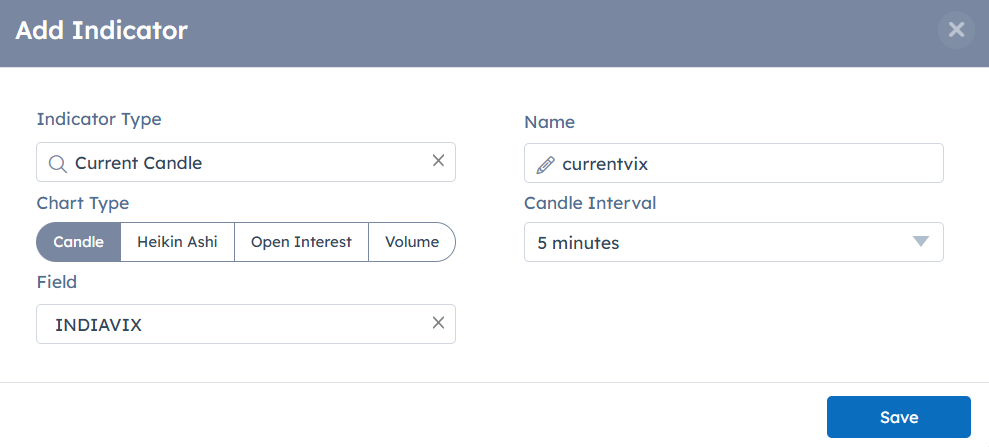
Once added, India VIX tells your strategy when the market is calm and when it is turbulent. This allows you to design rules that adapt automatically to volatility.
Practical Strategy Examples
- Entry Condition: Trade only when VIX is below 12, ensuring entry during calmer periods.
- Exit Condition: Close a trade when VIX crosses above 22, protecting profits from sudden spikes.
For example, if you have sold a put option and VIX rises sharply, it signals increasing volatility and the risk of sudden corrections. By using a VIX-based exit rule, you can exit early and protect your position. You can also combine India VIX with other indicators like Super Trend or Moving Averages. For instance:
- Enter a long trade only if Super Trend is bullish and VIX is below 15.
- Exit a short trade if Super Trend changes or VIX rises above 25.
Why India VIX Matters for Traders
Using India VIX in QuantMan adds a volatility lens to your strategy. It helps you:
- Avoid trades during extreme turbulence
- Capture opportunities when the market is stable
- Manage risk by exiting before volatility spikes
- Build strategies that benefit from both high and low volatility
Conclusion
India VIX is not just a number. It is a volatility signal that can refine entries, manage risk, and adapt strategies to changing market conditions. High VIX often benefits option sellers, while low VIX favors option buyers. By integrating India VIX into QuantMan, traders can build strategies that respond intelligently to volatility. So, next time you trade, do not just focus on the price chart. Add India VIX to your toolkit and let volatility guide your decisions.
Watch the video below to learn more about what India VIX is and how to use it in QuantMan